
Why an Online Store Needs More Maintenance Than a Website
An ecommerce site has more to break and more at stake than a brochure site. What online-store maintenance really involves, and why neglect costs a store real sales.
The short version
- A store has more moving parts than a brochure site — payments, checkout, stock, apps — so there's more to keep working.
- When a store breaks, it doesn't just look bad; it stops taking money. Every hour of a broken checkout is lost sales.
- Ecommerce maintenance adds store-specific jobs: testing checkout, watching payments, updating apps, and keeping product data healthy.
- For an online store, maintenance isn't housekeeping — it's protecting your income. The stakes are simply higher.
Every website needs looking after, but an online store needs more of it — and the cost of getting it wrong is higher. A brochure site with a glitch looks unprofessional. A store with a glitch stops taking money. That difference changes maintenance from housekeeping into something closer to insurance on your income.
Here’s why a store needs more care than a normal website, and what that care actually involves.
Why does an online store need more maintenance?
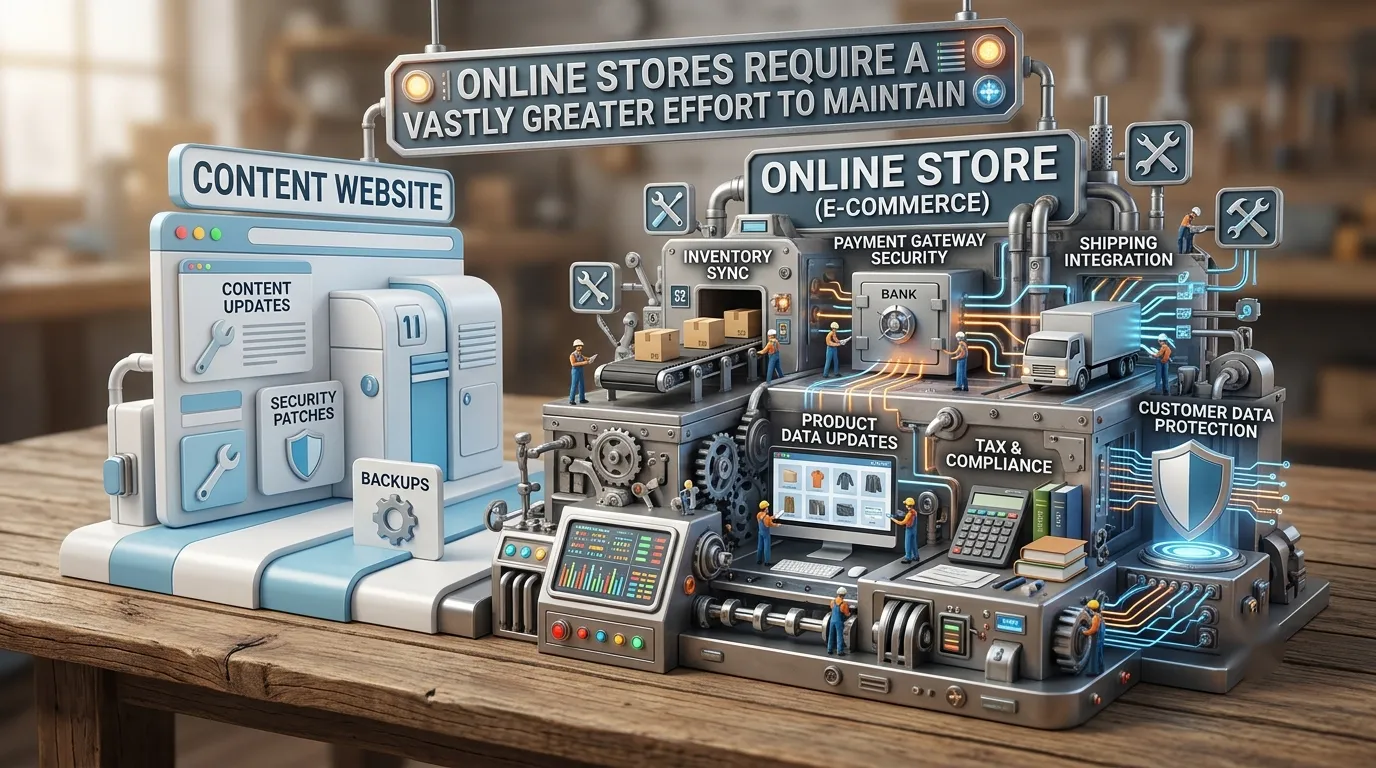
Two reasons: more parts, and higher stakes. An ecommerce site has payments, checkout, stock, shipping, tax settings and apps all working together — far more that can break than a brochure site’s handful of pages. And when it does break, it doesn’t just look bad, it stops selling. A broken checkout is lost revenue for every hour it’s down. More to go wrong, more to lose when it does.
More moving parts, more to keep working
A brochure site is mostly pages. A store is a machine with many interacting components:
- Payment gateway — must stay connected and working
- Checkout — the most important page you own; any fault here costs sales
- Product catalogue — images, prices, variants, stock levels
- Apps and plugins — reviews, shipping, email, upsells, each one another update to manage
- Shipping and tax — rules that need to stay correct
- Integrations — accounting, inventory or fulfilment tools
Every one of those can break or fall out of date, and several depend on each other. Update one app and another can clash. That interconnection is why a store needs more careful, more frequent maintenance than a static site.
When a store breaks, it stops earning
This is the part that makes ecommerce maintenance urgent rather than optional. On a brochure site, a broken contact form is annoying. On a store, a broken checkout means orders simply stop — and often silently, because customers don’t email to say “your payment page failed,” they just leave and buy elsewhere.
That’s the same invisible loss any broken site creates, but amplified: you’re not losing a possible enquiry, you’re losing a confirmed sale at the final step. It’s why a store belongs on the same footing as emergency repair readiness — every hour matters more.
What ecommerce maintenance actually includes
On top of the standard care every site needs — updates, security, backups, speed — a store adds jobs specific to selling:
- Test the checkout regularly — and after every change, so you find a fault before a customer does
- Watch payments — confirm transactions are going through cleanly
- Keep apps current and compatible — updated, and not fighting each other
- Maintain product data — accurate prices, stock, and structured data so products get found
- Check shipping and tax settings — still correct as rates and rules change
- Guard security tightly — a store handles customer and payment details, so staying patched isn’t optional
It’s the standard checklist plus a layer that exists purely because money is changing hands.
Brochure site vs online store: the care gap
| Brochure site | Online store | |
|---|---|---|
| Moving parts | Few | Many, interconnected |
| When it breaks | Looks bad | Stops selling |
| Security stakes | Moderate | High — payment & customer data |
| Testing needed | Occasional | Checkout tested regularly |
| Cost of neglect | Lost impression | Lost sales |
Same idea as a normal site, dialled up — because the store is your shopfront, your till and your stockroom at once.
Who should look after your store
You can maintain a store yourself if you’re diligent and technical — but the frequency and the stakes are why most owners don’t. Between running the business and filling orders, “test the checkout and update the apps” is exactly the job that slips, right up until the day a sale fails.
We build stores like OleOle and AWESIZE and keep them healthy, because a store that isn’t looked after is a shop with a jammed till you haven’t noticed yet. If a store you rely on isn’t on a proper plan, that’s a risk sitting quietly in the background — and the fix is a care plan built for ecommerce.
Want to know if your store is properly protected, checkout and all? Ask us to check it. We’ll test the parts that matter and tell you honestly where the gaps are before they cost you a sale.
Frequently asked questions
Does an online store need more maintenance than a normal website?
Yes. An ecommerce site has more moving parts — payments, checkout, stock, shipping and apps — so there's more that can break, and more that needs updating. It also has higher stakes: when a brochure site has a glitch it looks bad, but when a store breaks it stops taking orders, so maintenance directly protects your revenue.
What does ecommerce website maintenance include?
On top of standard maintenance (updates, security, backups, speed), an online store needs its checkout and payments tested regularly, apps and plugins kept current and compatible, product data and stock kept accurate, and shipping and tax settings checked. It also needs strong security because it handles customer and payment information.
What happens if I don't maintain my online store?
An unmaintained store risks a broken or insecure checkout, failed payments, out-of-date apps that clash, slow pages that lose buyers, and security holes that put customer data at risk. Because the store is how you take money, these problems translate directly into lost sales and damaged trust — often before you notice.
How often should an ecommerce site be maintained?
Ongoing, with some checks more frequent than a brochure site. Security patches should be applied promptly, the checkout should be tested regularly and after any change, and apps and product data reviewed often. Because a store is business-critical and updated frequently, most owners hand this to a maintenance service rather than track it themselves.
Sources
Want a hand with this?
We do exactly this. Take a look at Ecommerce Websites, or start with a free check.