
Does a Professional Website Actually Win You Business?
Is a professional website worth the money, or a nice-to-have? How a good site actually drives enquiries and sales — and when a cheap or DIY one quietly costs you.
The short version
- A website is where most people check you out before buying. A professional one builds trust; a poor one quietly sends them to a competitor.
- The return isn't the website itself — it's the enquiries, bookings and sales it brings in, minus the ones a bad site loses you.
- You rarely see the customers a weak site costs you. They just don't call. That invisible loss is the real price of 'saving' on the site.
- A good site pays back through more enquiries, higher trust, and being found on Google and AI search — compounding over years.
Spending a few thousand dollars on a website feels like a big call, especially when the business is ticking along on word of mouth. So it’s fair to ask the blunt question: does a professional website actually win you business, or is it just a nice-to-have?
The honest answer: a good one earns its keep, and a poor one costs you more than you think — you just never see the bill.
Does a professional website win you business?
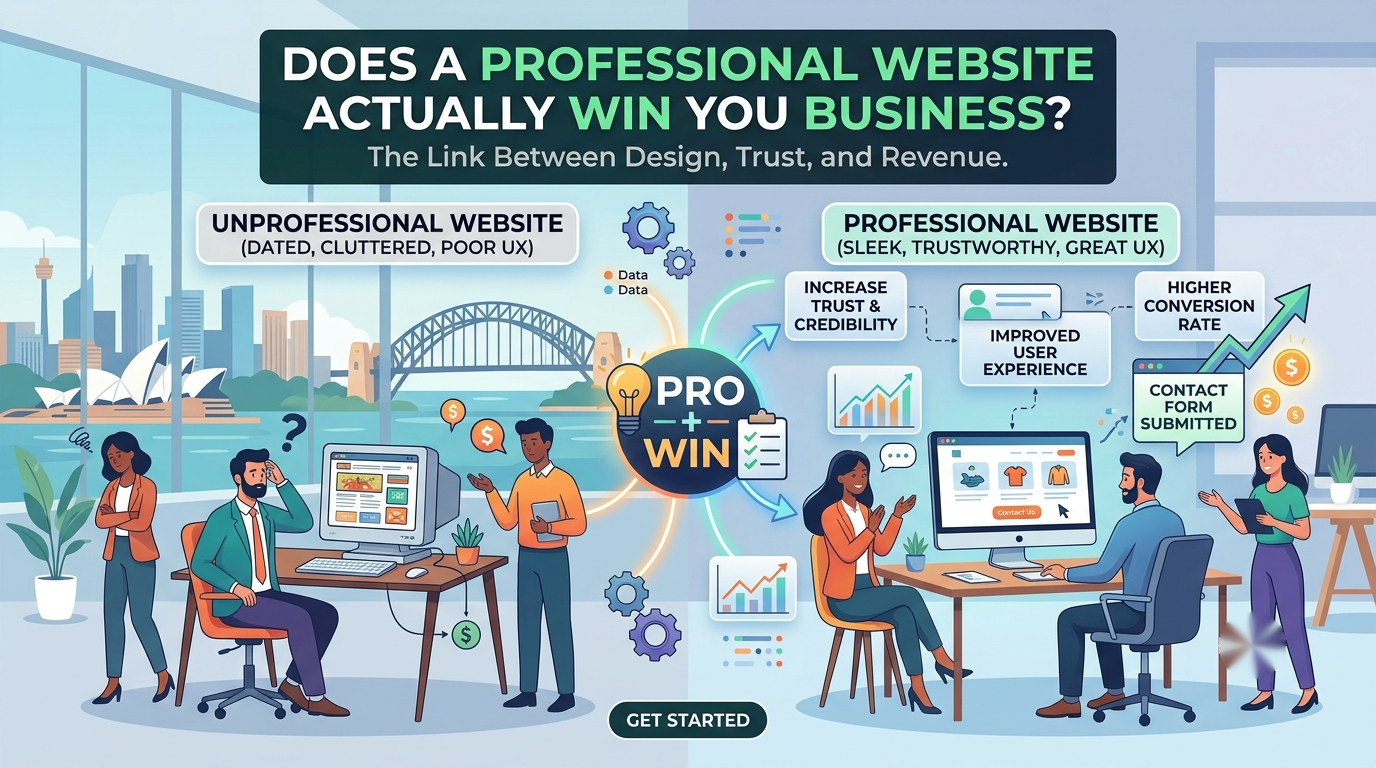
Yes, for most businesses. Your website is where people check you out before they buy — after a referral, an ad, a Google search or an AI recommendation. A professional site turns more of those visitors into enquiries and sales by making you easy to find, easy to trust, and easy to act on. A weak site does the reverse, quietly.
The website itself isn’t the return. The enquiries, bookings and sales it brings in are — minus the ones a bad site loses you.
The customers you never see
Here’s the part that makes this hard to judge: the cost of a poor website is invisible.
When someone lands on a slow, confusing or dated site and leaves, you get no notification. No missed-call alert, no bounced email. They just quietly go to a competitor whose site felt safer. You keep running, unaware you’re leaking business every week.
That’s why “we’re doing fine without a proper site” is a trap. You can’t miss customers who never reach out. A professional site’s first job is to stop that leak — and it’s the reason going without a real website costs more than it saves.
How a good website actually pays back
A professional site drives a return four ways:
- More enquiries from the same traffic. A clear message and an obvious next step convert more of the visitors you already get.
- Higher trust, better clients. A credible site helps you win bigger jobs and charge what you’re worth, instead of competing only on price.
- Being found. A fast, well-built site ranks on Google and gets recommended by AI answer engines, bringing in people who’d never have found you.
- It works around the clock, for years. Unlike an ad you switch off, a good site keeps earning long after it’s paid for.
Even a small lift in conversion, compounded over years, usually outweighs the build cost many times over.
Cheap, DIY or professional?
Not every business needs a top-end custom build. But it helps to see what each option really does for the return.
| DIY builder | Cheap build | Professional build | |
|---|---|---|---|
| Upfront cost | Lowest | Low | Higher |
| First impression | Varies, often generic | Fine at first | Strong, on-brand |
| Speed & Google | Often weak | Often weak | Built to be found |
| Converts visitors | Hit and miss | Hit and miss | Designed to convert |
| Real cost over time | Your time + lost enquiries | Often a rebuild in a year | Pays back through business won |
The cheapest option often costs the most once you count the rebuild and the enquiries lost in between — the full picture on pricing is worth a read before deciding.
When it’s not worth it (being fair)
A website isn’t a magic money machine, and it’s honest to say so:
- It converts demand; it doesn’t create it out of nothing. You still need people to reach the site.
- If your business is a hobby or winding down, a modest DIY site may be all it warrants.
- A great site with no traffic won’t perform — which is why the build and getting found go together.
For a business that wants to grow, though, the maths usually points one way.
What a website that wins business looks like
The sites that actually bring in enquiries share the same traits — the things that make a website good: fast, clear within seconds, easy on a phone, trustworthy, and pointing every visitor to one obvious next step. We built OleOle around exactly that: a clean, trustworthy path from browsing to checkout, so a new brand could start selling with confidence.
That’s the difference between a website as a brochure and a website as a salesperson that never clocks off.
If you’re wondering whether your current site is winning business or quietly losing it, ask us for an honest look. We’ll tell you where it’s working, where it’s leaking, and whether it’s worth improving or rebuilding — no hard sell.
Frequently asked questions
Is a professional website worth the money?
For most businesses, yes. A professional website is where customers check you out before they buy, and a good one turns more of them into enquiries and sales. The return is the extra business it wins, plus the customers a poor site would have quietly lost you.
Does a website actually increase sales?
A well-built site increases sales by making it easy to find you, trust you and act — book, buy or enquire. It won't magically create demand, but it converts more of the interest you already have, and a slow or confusing site does the opposite.
How does a website give a return on investment?
A website pays back through enquiries, bookings and sales it generates, and through the credibility that helps you win better clients. Because it works around the clock for years, even a modest lift in conversions can outweigh the build cost many times over.
Can a bad website lose me customers?
Yes, and it's the hidden cost. A slow, confusing or dated site makes visitors doubt you and leave for a competitor. You rarely see it happen — they simply don't get in touch — which is why the loss from a poor site is so easy to underestimate.
Sources
Want a hand with this?
We do exactly this. Take a look at Web Design, or start with a free check.