

What Should Be in Your Web Design Contract?
The clauses that protect you in a web design contract — ownership, scope, timeline, payment and what happens after launch. What to check before you sign anything.
The short version
- A web design contract should spell out who owns the finished site, domain and accounts — and the answer must be you.
- Get the scope, timeline, revisions and total price in writing, so 'extra' work can't quietly appear on the bill.
- Clarify what happens after launch: handover, training, support, and whether you can leave without losing your site.
- No contract, or a vague one, is itself a red flag. A clear agreement protects both sides and sets the tone.
A web design contract isn’t legal box-ticking. It’s the document that decides who owns your website, what you’re actually paying for, and what happens if things go sideways. Skip it, or sign a vague one, and you can end up locked out of your own site or hit with a bill you didn’t see coming.
You don’t need to be a lawyer to read one well. Here’s what a fair web design contract should cover, in plain English.
What should a web design contract include?
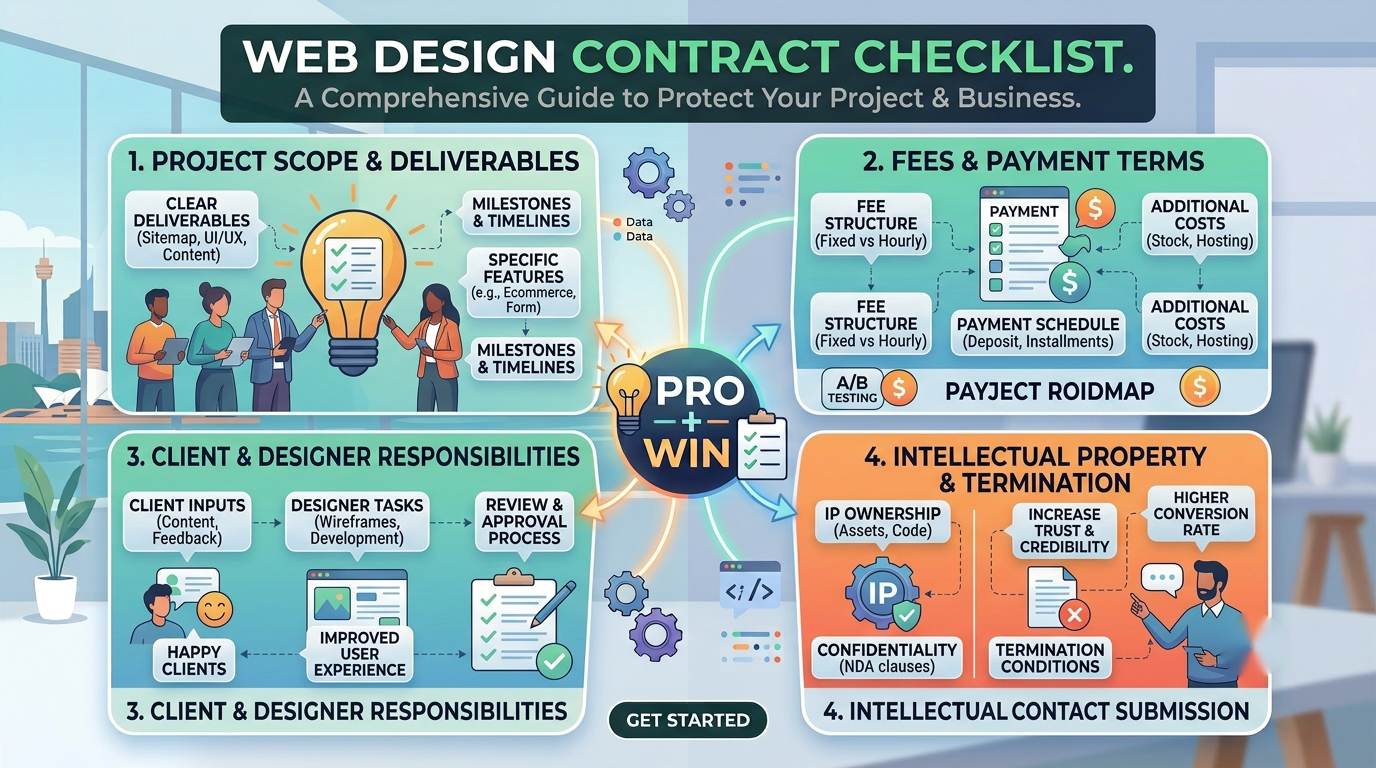
A solid web design contract covers six things: who owns the finished site and accounts, the scope of work, the timeline, the number of revisions, the total price and payment schedule, and what happens after launch. Get those in writing and you’re protected. Miss them and you’re trusting a handshake with your business’s online home.
Here’s each one, and what to look for.
1. Ownership — the clause that matters most
The contract must state clearly that, once you’ve paid in full, you own the finished website, its files, your domain name and every account tied to it. This is non-negotiable.
Some designers keep the domain, hosting or site in their own accounts, which quietly locks you in — you can’t leave, or move, or update without them. A fair contract transfers ownership to you outright, in line with basic copyright and IP rules. If ownership is vague or stays with the designer, that’s your cue to walk. It’s the clearest red flag when hiring there is.
2. Scope — exactly what’s being built
Scope is the list of what you’re getting: how many pages, which features, what content, who writes it. This is where “web design” turns from a vague word into a specific deliverable.
A clear scope also protects you from scope creep — extra work sliding in without a price. When the scope is written down, any addition is quoted and agreed, not billed as a surprise. If you’re comparing quotes, this is the section that explains why two prices differ so much, as we cover in how to read a web design quote.
3. Timeline — when things happen
A good contract sets a realistic timeline with milestones: design, build, review, launch. It should also note what’s expected from you (content, feedback, sign-off) and by when, because most projects that run late run late waiting on the client, not the designer.
Watch for either extreme: no timeline at all, or a promise that’s too good to be true.
4. Revisions — how many changes are included
Design involves feedback and changes. The contract should say how many rounds of revisions are included and what counts as a revision versus a brand-new request. This keeps the back-and-forth fair for both sides — you get proper input, and the designer isn’t redoing the site endlessly for free.
5. Price and payment — the full number
The contract should state the total price, not just an hourly rate, and set out the payment schedule (commonly a deposit up front, a payment at a milestone, and the balance on completion). Under Australian small-business contract rules, the terms need to be clear and not one-sided.
Make sure it also names what’s not included, so “extras” can’t quietly appear. A fixed price with a clear scope beats a vague hourly guess every time.
6. After launch — handover and support
A website isn’t finished at launch. The contract should cover:
- Handover — you receive all files, logins and access
- Training — how you’ll be shown to update the site yourself
- Support — what help you get after go-live, and for how long
- Ongoing care — whether there’s a maintenance plan, and that it’s optional, not a lock-in
We hand every client full control and offer care as a choice, not a leash — the way it should be. When Castle Hill Speech & OT launched, they owned everything and chose to stay on a care plan because it suited them.
A quick pre-sign checklist
Before you sign anything, confirm the contract answers:
- Do I own the site, domain and all accounts on final payment?
- Is the scope — pages, features, content — clearly listed?
- Is there a timeline with milestones?
- How many revisions are included?
- Is the total price and payment schedule spelled out?
- What handover, training and support do I get?
- Can I leave and take my site with me?
If it answers all seven clearly, you’re in good hands. If it dodges any, ask before you sign — a professional will happily clarify.
At 61WEB, no-lock-in ownership is baked into how we work, not buried in fine print. If you want a build with a clear, fair agreement from the start, have a chat with us and we’ll walk you through exactly what you’ll own.
This is general information, not legal advice. For a significant contract, consider having it reviewed by a professional.
Frequently asked questions
What should be in a web design contract?
A web design contract should cover ownership of the finished site, domain and accounts; the scope of work; the timeline; how many revisions are included; the total price and payment schedule; and what happens after launch — handover, training and support. It should also state you can leave with your site.
Who owns the website in a web design contract?
You should. The contract must state that on final payment, ownership of the finished website, its files, the domain and all accounts transfers to you. If a contract keeps ownership or control with the designer, don't sign it.
Do I need a contract for a small website project?
Yes. Even a simple site involves money, deadlines and ownership, and a written agreement protects both sides. A designer who won't put the basics in writing is a red flag — the contract is there to prevent disputes, not create them.
What is scope creep in a web design project?
Scope creep is when extra work gets added beyond what was agreed — more pages, new features, extra revisions — often without a clear price. A good contract defines the scope and revisions up front, so any additions are quoted and agreed rather than billed as a surprise.
Sources
Want a hand with this?
We do exactly this. Take a look at Web Design, or start with a free check.