
Hosting vs Maintenance: What's the Difference?
Hosting, maintenance, content updates — they sound similar and get confused constantly. What each one actually covers, what you need, and what you're paying for.
The short version
- Hosting is where your website lives. Maintenance is keeping it healthy. Content updates are changing what it says. Three different things.
- Paying for hosting doesn't mean your site is being looked after — hosting keeps it online, not updated or secure.
- Most businesses need all three, but they don't have to come from the same supplier or bill.
- Confusion here is where people get caught: assuming 'it's hosted' means 'it's handled.' It doesn't.
Hosting, maintenance, content updates. Three phrases that sound interchangeable, get muddled constantly, and hide a costly assumption: that if you’re paying for one, the others are handled. They’re not. Each is a different job, and knowing the difference stops you either overpaying or, worse, thinking your site is looked after when nobody’s touched it in a year.
Here’s what each one actually means, in plain terms.
Hosting vs maintenance vs content updates: the short version
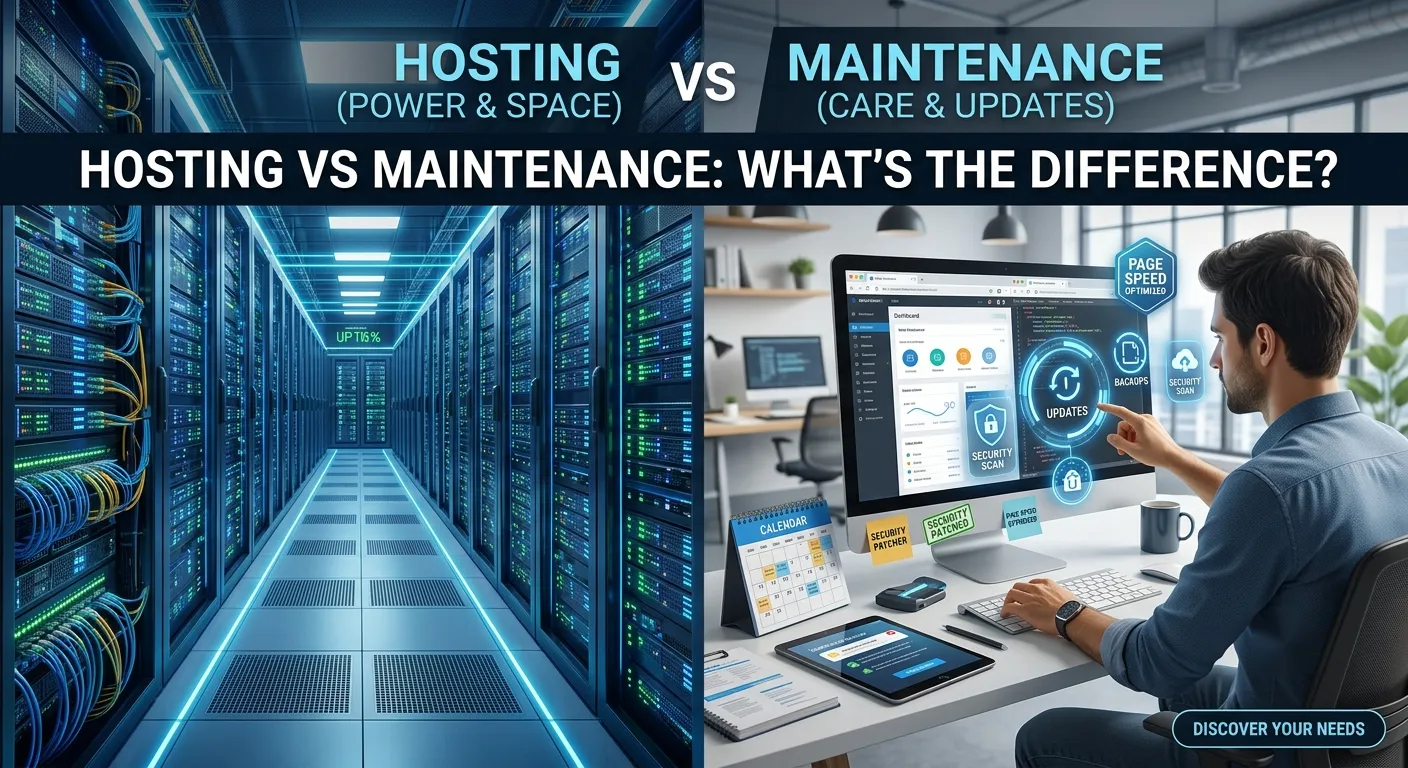
Hosting is where your website lives. Maintenance is keeping it healthy. Content updates are changing what it says. You need all three functions, but paying for one doesn’t cover the others — and that’s exactly where people get caught out.
| What it is | What it covers | Without it | |
|---|---|---|---|
| Hosting | The server your site lives on | Keeping the site online and reachable | Your site is offline |
| Maintenance | Ongoing technical upkeep | Updates, security, backups, speed, fixes | Site drifts, breaks, gets hacked |
| Content updates | Changing what the site says | New text, images, prices, products, pages | Site goes stale and out of date |
Hosting: where your website lives
Hosting is the space on a server where your website’s files sit, so anyone typing your address can load it. Every live site needs it. Think of it as the land your shop is built on — without it, there’s nowhere for the shop to be.
But here’s the crucial bit: hosting only keeps you online. A hosting company makes sure the server is running. It does not log in and update your site, take backups of your content, watch for security problems, or fix things that break. That’s a different job entirely — and assuming otherwise is the mistake that ends in an emergency call when the site goes down.
Maintenance: keeping the site healthy
Maintenance is the ongoing work that keeps a live site secure, fast and working:
- Software updates — platform, themes and plugins kept current
- Security — patching known holes before bots find them
- Backups — recent copies you can actually restore
- Speed — keeping the site quick as it grows
- Fixes — sorting things when they break
This is the part hosting doesn’t touch. It’s the difference between a site that’s merely online and one that’s actually looked after — the full picture is in our website maintenance guide.
Content updates: changing what it says
Content updates are changes to what your website actually shows: new text, fresh photos, updated prices, added products, a new page. This isn’t technical health — it’s keeping the site current with your business.
Some care plans include a set amount of content updates each month; others keep them separate and quote per change. Neither is wrong, but you want to know which you’ve got, so “can you update our prices?” doesn’t come with a surprise fee.
The assumption that catches people out
The single most common mix-up we see: a business pays a hosting bill, assumes that means their site is “handled,” and does nothing for two years. Then the site is slow, out of date, running old software, with no backups — and one bad day it breaks or gets hacked.
Nobody did anything wrong on purpose. They just assumed hosting meant maintenance. It never did. The Australian Cyber Security Centre is blunt that keeping software updated is on the site owner, not the host.
Do you need all three separately?
You need all three functions — but not necessarily as three bills from three suppliers.
- Hosting is essential and often stands alone.
- Maintenance and content updates are frequently bundled into one care plan.
- Some providers wrap all three together.
What matters is that all three are actually covered by someone, and you know who. The gap to avoid is any function that’s nobody’s job.
The simple way to handle it
The cleanest setup for most small businesses is a single care plan that covers maintenance (and usually a set amount of content updates), with hosting either included or clearly sorted alongside it. One point of contact, nothing falling through the cracks.
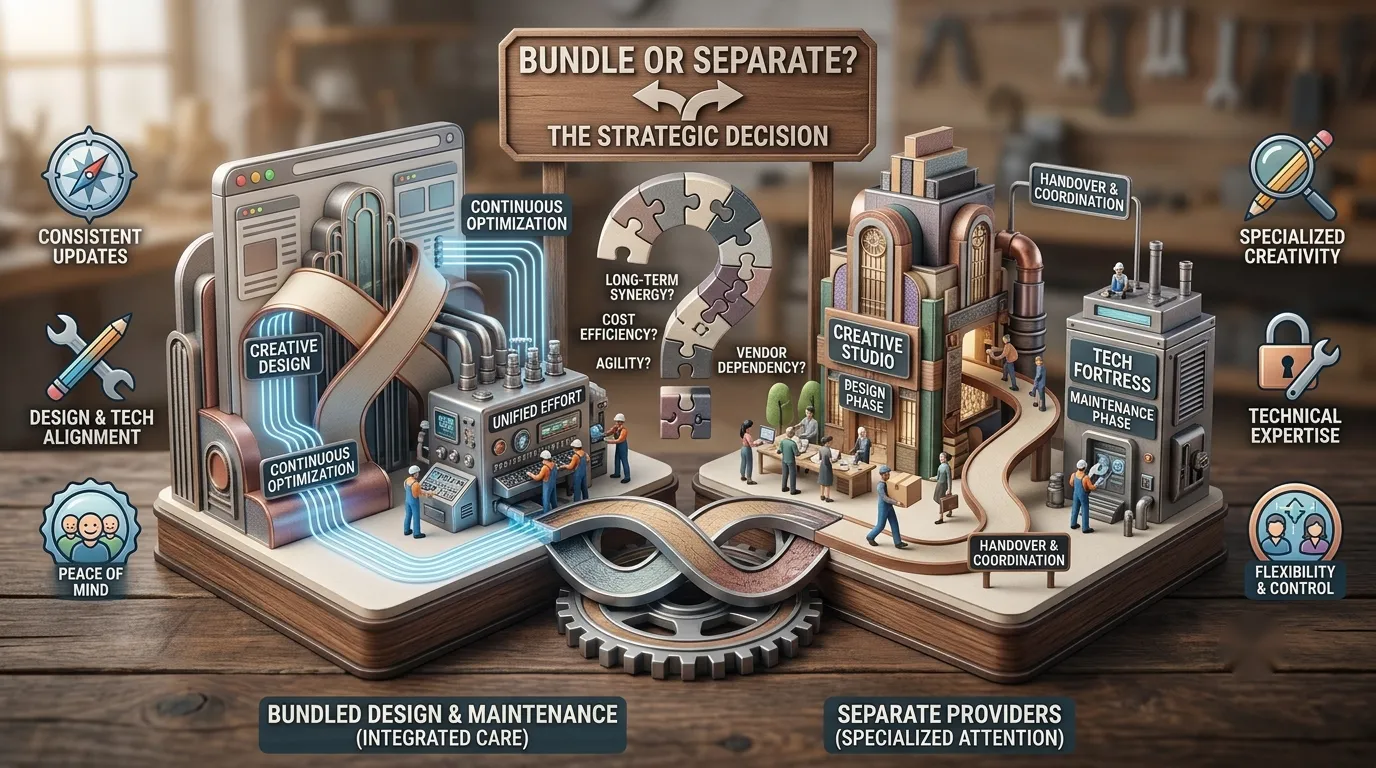
That’s how we look after clients like Castle Hill Speech & OT: the site stays fast, secure, current and online, and they have one number to call — no wondering which supplier owns which problem. If bundling appeals, our take on combining design and maintenance goes further.
Not sure what’s actually covered for your site right now? Ask us — we’ll help you work out what you’re paying for, what’s missing, and whether “it’s hosted” is quietly leaving you exposed.
Frequently asked questions
What's the difference between website hosting and maintenance?
Hosting is the service that keeps your website online and accessible — the space on a server where your site lives. Maintenance is the ongoing work that keeps the site healthy: software updates, security, backups, speed and fixes. Hosting keeps your site available; maintenance keeps it working well and safe.
Does paying for hosting mean my website is maintained?
No. Hosting only keeps your site online. Unless you've specifically bought a maintenance or care plan, no one is applying updates, taking backups, watching security or fixing issues. Many businesses are caught out here — 'it's hosted' does not mean 'it's looked after.'
What's the difference between maintenance and content updates?
Maintenance is technical upkeep — updates, security, backups, speed and fixing things that break. Content updates are changes to what the site says: new text, images, prices, products or pages. Some care plans include a set amount of content updates; others treat them separately. Check what your plan covers.
Do I need hosting, maintenance and content updates all separately?
You need all three functions, but not necessarily as three separate bills. Hosting is essential to be online; maintenance keeps the site secure and working; content updates keep it current. Many providers bundle maintenance and content updates into one care plan, sometimes including hosting too.
Sources
Want a hand with this?
We do exactly this. Take a look at Website Maintenance & Support, or start with a free check.